




Appointments
Request Appointment/Request Exam - After completing the respective forms, these requests will be processed by our services, and you will receive confirmation by email. The indications about the Agreements (Insurance/Subsystem) are merely informative, please request confirmation in the "Observations" field.
Schedule Appointment/Exam myHPA - By accessing myHPA Saúde you can make the appointment in real time, directly on the Doctor's schedule according to his availability.
You can also contact us at +351 282 420 400 Algarve | +351 269 630 370 Alentejo | +351 291 003 300 Madeira
Phone booking/service hours:
Monday to Friday: 8:00 AM to 7:00 PM, Saturday: 8:00 AM to 5:00 PM Sunday and Holidays: Closed
(National landline)
Your request has been successfully received. We will confirm your appointment shortly.
Download myHPA Saúde:


Vitiligo
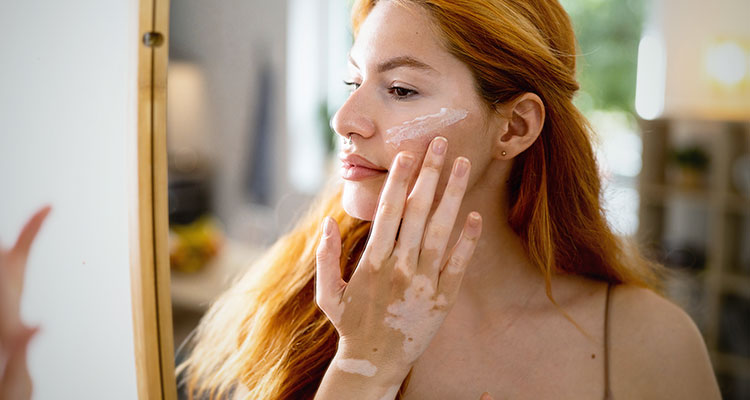
Vitiligo is a chronic condition characterised by the loss of skin pigmentation. Lesions occur due to a decrease or absence of melanocytes (the cells responsible for producing melanin, the pigment giving skin its colour). The exact cause is not fully understood, but autoimmune alterations appear to be associated with vitiligo. Emotional stress or trauma may also trigger or worsen the condition.
Vitiligo usually begins around the age of 20, with lesions that may stabilise, improve, or expand over time. Depigmented patches often appear symmetrically, affecting areas such as the eyelids, corners of the mouth, nipples, hands, feet, beard area, navel region, and genitals. In rare cases, the skin may regain its original pigmentation. These areas require strict sun protection year-round to prevent burns and reduce skin cancer risk.
While there is no cure for vitiligo, several treatments can aid in repigmentation of affected areas. Therapeutic options include topical corticosteroids, calcineurin inhibitors (immune system enzyme modulators), narrowband UVB phototherapy, photochemotherapy, and Excimer laser therapy. Although effective in some cases, these treatments may cause side effects such as dry or itchy skin.
- Dr. André Laureano
- Dr. Duarte Flor
- Dra. Virginia Coelho de Sousa
- Dr. João Guilherme do Patrocínio
- Dra. Bárbara Roque Ferreira
- Dra. Cristina da Silva Sousa
- Dr. De Lorenzo
- Dr. João Guilherme do Patrocínio
- Dr. Vitor Neto
- Dra. Christine Schoutens
- Dr. Bruno Duarte
- Dr. João Guilherme do Patrocínio
- Dr. Pedro Vale Fernandes
CUF Alvor Hospital
Hospital São Camilo - Portimão
CUF Chinicato - Lagos Clinic
CUF Guia - AlgarveShopping Clinic
CUF Montenegro - Faro Clinic
CUF S. Brás de Alportel Clinic
CUF Sines Hospital
Beja Private Clinic
CUF Funchal Clinic
| Find all the information regarding Specialities and Consultations at CUF Healthcare Units in Greater Lisbon, the North, Centre, and the Azores here. |